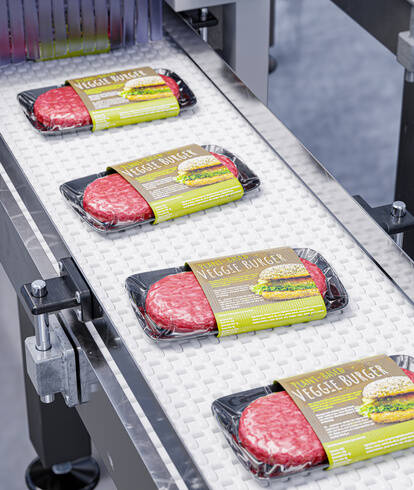
Plant‑based manufacturing enters its next phase: agility, scale and strategic restraint set to define 2026




The plant‑based sector is heading into a pivotal year as engineering specialists predict a decisive shift in how food and beverage manufacturers design, operate and invest in their facilities.
According to global consultancy Niras, 2026 will be shaped by two converging forces: the need for far greater manufacturing agility, and the long‑awaited scaling of plant‑based protein production.
After several years of economic turbulence, Niras argues that the industry is now entering a period where operational flexibility and capital discipline will matter as much as innovation itself.
Jonas B. Borrit, Vice President for Process Industries at Niras, says the pressures that defined 2025 – volatile tariffs, sluggish economic growth, rising labour costs and unpredictable consumer behaviour – are not going away. If anything, they are becoming structural.
“Manufacturers will need to be more adaptive and more innovative,” he notes, pointing to a growing emphasis on “capital avoidance”: maximising existing assets before committing to new expenditure. With budgets under scrutiny, he expects this mindset to become a defining feature of 2026 investment strategies.
Borrit and his colleagues – Nick Hickman, VP for business development, and engineering expertise manager Jolmer Nieuwkerk – outline five trends they believe will shape the year ahead.
Nieuwkerk, whose background spans both dairy and alternative proteins, believes 2026 could mark a turning point for the plant‑based category.
Consumer demand remains strong, he says, fuelled by better product quality and heightened awareness of the environmental impact of animal proteins. But the real momentum is coming from the manufacturing side, where a wave of start‑ups is pushing products from pilot to factory scale.
Their biggest hurdle? Access to capital and technical expertise.
“Turning a great idea into a safe, scalable and profitable operation is still the biggest challenge,” Nieuwkerk explains.
He also highlights the rise of hybrid protein products – combinations of plant‑based and animal‑based ingredients – as a pragmatic bridge in the protein transition. These products, he argues, allow manufacturers to reduce animal content while maintaining familiar textures and processing characteristics.
But scaling plant‑based production will require new thinking around hygienic design, process suitability and flexible plant layouts.
Sustainability is no longer a “nice to have” – it is now inseparable from cost control, Borrit says. Lower emissions, higher energy efficiency and reduced operating costs are becoming essential for competitiveness.
Emerging technologies are expanding the options available to manufacturers. Heat pumps capable of higher temperatures, green fuels and power‑to‑X solutions are opening new pathways for decarbonisation.
“These technologies are broadening what’s possible,” Borrit notes, suggesting that 2026 will see more manufacturers integrate advanced energy systems into both new builds and retrofits.
Hickman says macroeconomic instability has slowed or stalled many capital projects in 2025. As a result, he expects 2026 to bring a sharper focus on total cost of ownership (TCO) as companies justify every investment.
“TCO analysis will be essential for assessing project viability,” he says. “It will help businesses continue investing in capacity and efficiency improvements despite tighter financial conditions.”
Speed‑to‑market remains a critical competitive advantage, but cost pressures mean manufacturers must achieve it without expanding their physical footprint unnecessarily.
Hickman argues that the industry must rethink traditional factory design. Facilities built for single high‑volume SKUs are increasingly misaligned with today’s fragmented, fast‑moving markets.
“A factory designed for multiple products has always been inherently flexible,” he says. “That flexibility now needs to be built into the design process from the start.”
The shift toward capital avoidance reinforces this trend, with manufacturers prioritising upgrades and reconfigurations over new builds.
Niras also anticipates more production sites being located closer to urban centres. While this helps attract and retain skilled staff, it introduces new supply‑chain complexities and intensifies pressure on space‑efficient, modular plant design.
At the same time, many existing European facilities face mounting pressure to refurbish rather than replace, with payback periods and productivity gains now central to investment decisions.
Taken together, these trends suggest that plant‑based manufacturing is entering a more mature, strategically disciplined phase. The exuberance of early innovation is giving way to a focus on scale, efficiency and operational resilience.
If 2025 was the year of recalibration, 2026 may be the year the plant‑based sector proves it can industrialise – without losing its agility.